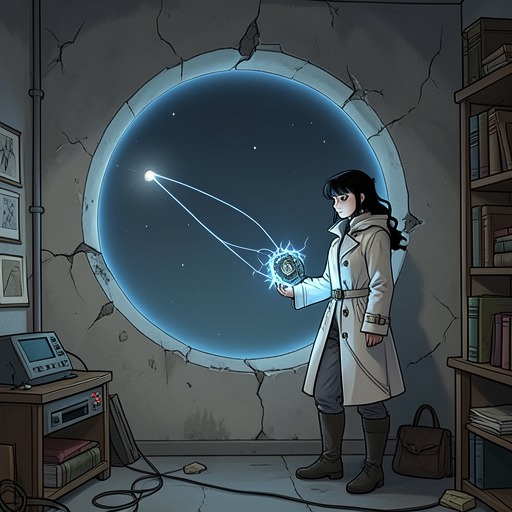
Wormhole generator
The Stars Have EyesThe Wormhole generator is the central transit technology of the setting, turning interstellar distances into brief passages through an artificial black hole while making the boundary between realities materially dangerous. Its importance is double-edged: it is the infrastructure that allows Joe Mulligan and Maggie to travel between star systems, but it is also the suspected source of escalating spatial damage and the force that repeatedly ejects Magh'rathlak the Observer's consciousness from the material realm.
Design and Operation
The device creates and sustains an artificial black hole while simultaneously producing a counter-gravitational field to preserve the vessel around it. That combination generates such an immense energy output that an unprotected living creature within a hundred kilometers would be instantly liquefied. Wormhole generators are therefore enclosed behind extensive layers of radiation and energy shielding. On the ICF-M42 Trafalgar, those layers were so effective that they also blocked Maggie's ability to see through the chamber with psionics, despite the shielding not being intentionally designed to impede such powers.
The shielding's accidental interference with psionics becomes more than an engineering curiosity. Maggie suspects that the same physical properties may be connected to the lasting damage the generator inflicts on the fabric of reality. She cannot immediately examine the generator chamber without violating her obligations to the Third British Empire, so the machine remains partly inaccessible even to a Class-3 cosmic entity with an exceptional ability to inspect matter and systems. The generator is thus presented as both a comprehensible piece of infrastructure and a technological mystery whose most consequential effects exceed its designers' apparent intentions.
Transit Experience
For ordinary passengers, a wormhole jump is extraordinarily short but embedded in a much longer and more stressful journey. Joe's voyage to Lancaster-3 would require ten hours on a shuttle, six hours while a freighter maneuvered into position, a jump lasting roughly twenty seconds, and another thirteen hours of flight after emergence. The total journey would take about thirty hours, much of it unbearable for someone with Astrohodophobia. A sleeper brace could induce a harmless coma for the voyage, but Joe rejects it because he believes Maggie wants to share the experience with him and because he does not want to appear cowardly before the woman he loves.
The jump itself follows a strict physical procedure. Passengers are warned to strap themselves in or hold onto something because artificial gravity is disabled. On the ICF-M42 Trafalgar, Joe is startled awake by the announcement that the ship will jump in ninety seconds, then clings to the bars of his cot as weightlessness begins. The transit produces a bizarre sound, several seconds of complete sensory deprivation, and a violent return of gravity that throws him against the bed. On a later voyage aboard The Queen Mary, automated belts and cuffs secure Joe and Maggie in armchairs before the same sound and sensory blankness recur. The procedure is technologically routine for the crews, but to Joe it remains a bodily confrontation with weightlessness, disorientation, and the possibility that the ship may not return him safely to ordinary experience.
Effects on Maggie and the Vessel-and-anchor Linkage
The Wormhole generator has an especially severe effect on Maggie because she is not native to the material universe. Her existence in that realm depends on a vessel-and-anchor connection: a physical form and Joe's willing mind together provide the focal points that let her maintain and reassert her presence. The arrangement gives Magh'rathlak the Observer freedom to study humanity through Maggie, but it is not stable during wormhole transit.
When a generator tears open reality, it carries away Maggie's vessel and Joe's psychic anchor while leaving her alien consciousness behind. Detached from both supports, she is instantly pulled back into her native dimension through the same breach, regardless of her wishes. After the first jump, she explains that her consciousness was forcefully ejected and confirms that the event will recur because she is a foreigner to the reality through which the ship travels. Her human manifestation may therefore remain aboard the vessel while the consciousness animating it is displaced beyond the material border.
The recurrence becomes a familiar routine for the couple. During one later jump, Maggie's empty body sits with dull, vacant eyes and motionless hair while Joe waits for her consciousness to return. She normally finds her way back after about fifteen minutes, but Joe hastens the process with a kiss. The gesture is unnecessary as a technical remedy, yet it has become appreciated within their relationship, transforming a dangerous infrastructural side effect into an intimate ritual. The machine repeatedly separates them, while their learned response to that separation reasserts their bond.
Spatial Damage and Imperial Policy
Maggie identifies the Wormhole generator as the cause of the breach events that have increased in frequency and severity across the past three hundred years, particularly in densely populated systems. The Supernatural Eviction Agency has observed the trend without understanding its source, and Oliver Millington seeks Maggie's advice because her knowledge of cosmic entities and dimensional crossings exceeds the Agency's own records. Her immediate diagnosis shifts the issue from supernatural mystery to technological responsibility: the generators themselves are damaging the reality they are designed to connect.
She later narrows the likely cause to the irradiated gases produced during operation. Vessels of the Third British Empire vent those gases into space immediately after a jump, whereas ships belonging to the Mostly United Republic of Inter-Cosmic America are required to contain and recycle them. The American regulation was introduced primarily for economic reasons. The Mostly United Republic of Inter-Cosmic America handles more interstellar traffic but has less access to the fuel sources and raw materials needed to sustain it, so it cannot afford to discard the gases as freely as the British do. The difference in recycling practice is consequently also an environmental and cosmological difference, making British space the likelier site of elevated spatial erosion.
Maggie is not yet absolutely certain and would need further experiments and observations of working generators to confirm the conclusion. Nevertheless, the suspected mechanism gives the Wormhole generator a political dimension. The machine does not merely transport passengers; its operation distributes risk across imperial territory, and the choice between venting and recycling determines who inherits the damage. The device's apparent efficiency therefore conceals a maintenance and disposal regime whose consequences accumulate beyond any single voyage.
Narrative and Material Significance
The Wormhole generator destabilizes the assumption that advanced infrastructure is neutral or fully controlled. It compresses a trip that would otherwise be impossible into a twenty-second jump, yet that convenience carries sensory deprivation, violent re-entry, environmental contamination, reality erosion, and the repeated displacement of a sentient consciousness. The generator's effects exceed the intentions of the people who operate it: shielding blocks psionics accidentally, waste policy alters the condition of space, and transit turns a romantic partnership into a recurring negotiation with dimensional separation.
Its role also contrasts with the mundane technologies surrounding the characters. Joe's life depends on a Full Immersion Pod 3,000™, V-Life, automated transport, and a vertical urban system, while the Wormhole generator opens a much larger and less domesticated scale of technological power. The difference is not simply one of size. The pod can become familiar enough to use daily, even after being infused with a Shoggoth, whereas the generator remains opaque, shielded, and capable of altering reality itself. In this contrast, the device embodies the setting's broader tension between ordinary dependence on infrastructure and the cosmic forces that infrastructure quietly unleashes.